


We dedicate this report to Peter Kirby, a beloved pillar of Climate XChange for over a decade.
Peter wore many hats at CXC. He served as our Board Chair and stepped in as Interim Executive Director for our organization in 2021. He left an enduring mark on our programming — helping to create the State Climate Policy Dashboard and shape the State Climate Policy Network into what it is today. For over eight years, he poured his genuine love of electric vehicles into our Annual EV Raffle, connecting with participants who felt his enthusiasm firsthand.
But what made Peter truly special was how he showed up for people. He led with empathy. He offered warmth and encouragement to everyone on our team and he believed, deeply and without reservation, that our work matters and that states will make progress on climate change.
Peter helped build the foundation of this organization, and his legacy is woven into everything we do. We are committed to honoring his vision by pressing forward with the work he cared so much about.
Our hearts go out to his family, friends, and all who knew him. His vision will carry us forward.
Introductory Letter
2025 was a year that tested the resilience of the state climate movement and proved its strength.
When the Trump administration took office in January, it moved swiftly to dismantle federal climate commitments: rescinding clean energy funding, rolling back pollution standards, and challenging the very jurisdiction of states to act. The pace and scope of these reversals demanded an immediate response. At Climate XChange, we understood that our role had never been more important: to help state actors cut through the noise, understand what was changing and why, and identify what they could do about it.
And the good news is that states can do a lot. States have the widest jurisdiction to tackle decarbonization across most sectors of the economy, and no federal administration can take that away. In 2025, we saw states demonstrate exactly that kind of resolve, and our job was to equip them with the tools and research to act with confidence and ambition.
To that end, we expanded our newsletter coverage, tracking federal and state-level backsteps alongside progress, ensuring our State Climate Policy Network always had an honest picture of the policy landscape, not just the wins. Our team tagged and tracked over 2,300 bills, hosted 33 events reaching over 2,600 attendees, and published webinars and analyses that repeatedly addressed the same essential question: what can states do? From EPA rollbacks and the One Big Beautiful Bill to the surge of data centers reshaping state energy grids, we worked to make sure state actors were never without answers and were empowered with resources to move climate policy forward.
We also continued deepening the resources available through our State Climate Policy Dashboard, which drew 233,000 views from 58,000 users in 2025. We completed two major content updates, added five new policies, and conducted a comprehensive external review with state actors across 30 states — all in service of making the Dashboard the most useful, comprehensive tool possible for the advocates and policymakers who rely on it.
None of this work happens without a dedicated team, a committed Board of Directors, and the generous community of supporters and funders who believe in this common mission. I am deeply grateful to all of them. We dedicate this impact report in the memory of Peter Kirby, whose belief in our mission and its critical importance will continue to inspire everything we do.
The climate movement faces real turbulence in the years to come, but at Climate XChange, we remain committed to our mission. States are where progress towards climate goals is made, and we will continue to do everything in our power to make sure policymakers and advocates have the knowledge, tools, and community to lead.
With your support, we move forward!

Paola Ferreira Miani, Executive Director
2025 By the Numbers

233,000
VIEWS
from 58,000 USERS on the State Climate Policy Dashboard

90
SUBJECT MATTER EXPERTS
featured on our programming

2,390
BILLS TRACKED
to deliver our policy updates

305
POLICY UPDATES COVERED
through 24 NEWSLETTERS, covering 50 STATES and the FEDERAL GOVERNMENT

3,800+
STATE GOVERNMENT STAFF
in our network

2,655
ATTENDEES
reached through 33 EVENTS

1,371
STATE CLIMATE POLICY NETWORK MEMBERS
participated in our Transmission Series cohort

4,510
INDIVIDUAL DONORS
supported our work

91
ASSISTANCE REQUESTS COMPLETED
including 28 for STATE LEGISLATORS, 43 for NGOs, and 6 for LOCAL AND STATE OFFICES
38
STATE ACTORS
across 30 STATES, participated in our first external review of our redesigned Dashboard
Key Moments in 2025
JANUARY
Dashboard
Completed our first Dashboard content update of the year, reviewing all policy data to reflect newly enacted policies across all 50 states.
Newsletter
Expanded our bi-weekly newsletter to include a dedicated federal updates section tracking Trump administration rollbacks.
MARCH
Research | Events
Analyzed how states can fill the gaps left by EPA’s climate deregulation and hosted a companion webinar identifying concrete state-level responses to EPA’s sweeping rollback announcements.
APRIL
Events
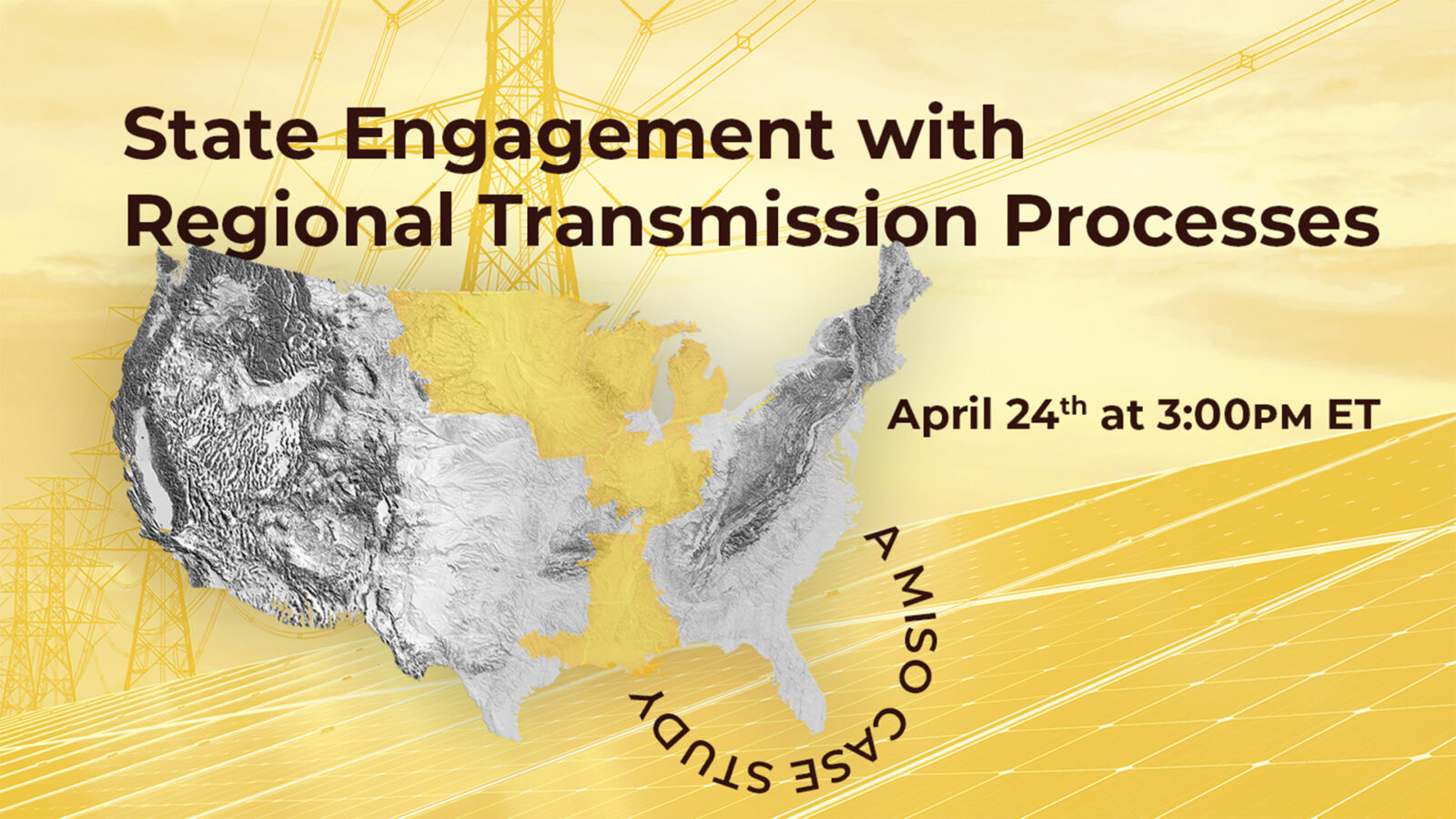
Continued the Transmissions Series we launched in November 2024 with a panel discussion featuring experts involved in the regional planning process for MISO, the grid operator for the central United States.
MAY
Events
Hosted our first-ever data center listening session with SCPN members, surfacing how rapid data center buildout is already affecting state climate targets, energy costs, and local communities.
JUNE
Events
Convened a webinar focusing on how states can fill in the gaps left by federal clean vehicle rollbacks, equipping state actors with responsive policy tools for transportation electrification.
JULY
Dashboard
Completed our second Dashboard content update of the year, gathering feedback from 38 state actors across 30 states and two sectors.
Research | Events
Released a joint analysis with Evergreen Action about how states can address the policy gaps left by the One Big Beautiful Bill Act, and hosted a companion webinar drawing hundreds of attendees across the country.
SEPTEMBER
Fundraising
Launched our 10th Annual EV Raffle, garnering support from over 3,500 supporters.

Research | Events
Published our mid-year trends insights and hosted a companion webinar, covering data centers, anti-renewable legislation, community solar, and transportation electrification.
OCTOBER
Events
Launched our Future of Gas 101 webinar series, providing SCPN members with deep analysis of the policy landscape around the transition away from natural gas at the state level.
NOVEMBER
Events
Released our initial data center research through our webinar, Where States Stand on Data Centers, presenting findings from tracking 140 pieces of state data center legislation introduced in 2025 sessions.
DECEMBER
Research
Published our year-end archive, 2025 State Climate Updates: Our Full List of Enacted Policies and Trends, documenting the full arc of state climate action across all 50 states.
Highlighting the Role of States Under an Anti-Climate Federal Administration
When President Trump took office in January, our staff at Climate XChange understood that state actors were facing an unprecedented barrage of news about federal rollbacks that demanded timely analysis and guidance. We emphasized that, while rescinding federal funding, threatening clean energy deployment, and rolling back pollution standards could set the country back substantially, states have an extensive array of tools at their disposal to fill each of these gaps. We highlighted the leadership and courage of states that remained undaunted in their climate action. And, finally, we continued to remind state actors that no matter what administration takes the reins in Washington, state governments retain the widest jurisdiction to tackle decarbonization across the major sectors of the economy. Statehouses are where issues like building emissions, charging networks, electricity supply, and more will have to be tackled, and under any administration, statehouses have an obligation to lead.
Climate XChange took several strategic initiatives in 2025 to help provide state actors with guidance on navigating the impacts of the Trump administration’s climate policies. First, we reframed our newsletter to call out federal updates that impact state climate policy, helping readers understand what policies were in retreat and how states could respond. Our updates included highlights on the flurry of Executive Orders from President Trump’s first day in office, resources for federal grantees as the administration took aggressive steps to revoke Biden-era grants, context and analysis for major EPA deregulatory announcements, and notes on the impact of Executive Orders that specifically challenged the rightful jurisdiction of states to regulate climate pollution. We also provided more regular coverage of federal policy and funding changes across the board, helping our network track the changes that mattered amidst the whirlwind of noise.

Second, we published analyses and targeted our SCPN webinars throughout the year on what states can do to counteract the impacts of federal policy changes. Back in March, our analysis identified concrete ways that states could fill the gaps left by each of EPA’s announced climate-related rollbacks, and our responsive webinar was keynoted by Janet McCabe, EPA’s second in command under the Biden Administration. When it came time to assess the One Big Beautiful Bill Act over the summer, our analysis of state tools to mitigate the bill’s impacts was joined by Evergreen Action, and our webinar on the topic drew hundreds of eyes across the country. As transportation proved to be one of the most vulnerable sectors to federal rollbacks, we hosted a special webinar in June calling out responsive tools for states, and returned to this theme again in December, when we highlighted state tools to expand charging networks.
Time and time again over the year, we saw that state actors need help navigating the aggressive flow of policy reversals coming from the current administration. And time and time again, our team at Climate XChange has been able to help identify what news mattered, contextualize why, and point state actors to what they can do to help fill emerging policy gaps. We know this work will continue in 2026 and beyond, and we’re proud to serve this important function in the climate movement.
Delivering Policy Information
Providing Foundational Policy Information and Tailored Policy Assistance
In October 2024, Climate XChange released our redesigned State Climate Policy Dashboard, creating a user-friendly website that simplifies policy research by compiling state-level climate policy information and resources in one place. In 2025, we continued to improve and update the tool. In addition to functional updates that make finding information easier, like adding a site-wide search tool, we completed two content updates to the platform in January and July to reflect newly enacted policies and rollbacks. To ensure these updates stayed true to on-the-ground perspectives, we also executed an external review of the new Dashboard, receiving feedback on our policy coverage from 38 state actors across 30 states.
The Dashboard also powers the tailored pro bono technical assistance we provide network members. In 2025, we completed 91 assistance requests for policymakers and advocates, helping inform decisions in state legislatures across the country. This support spanned all states and sectors, from identifying opportunities for methane reduction policies in Delaware to providing best practices on cumulative impact assessments legislation in Illinois.
In 2026, we will continue adding policies to the Dashboard and implementing improvements to the tool. We’re also working to identify high-impact Dashboard policies states can enact given their specific political and policy landscapes. We will highlight the benefits of these policies across sectors to enable data-driven decision-making.
Five Policies Added to the State Climate Policy Dashboard
We added five Dashboard policies to highlight additional opportunities for states that help advance new pro-climate initiatives and defend against anti-climate campaigns. The new policies were:
- Environmental Rights Amendments: Amend a state’s constitution to guarantee the right to a clean and healthy environment.
- Divestment: Ends new investments of public funds in the fossil fuel industry and phases out existing investments.
- Consolidated State Authority for Siting and Permitting: Gives a state the decision-making authority over siting for renewable energy projects.
- Enabling ATTs and GETs: Promote advanced transmission technologies (ATTs) and grid enhancing technologies (GETs) that enhance grid capacity more quickly and at a lower cost.
- Thermal Energy Networks: Facilitate the creation of neighborhood-scale energy projects, allowing multiple buildings to be connected to distribute underground heating and cooling.

Delivering Timely Policy Updates
With an anti-climate federal government rapidly reversing policy and funding decisions for states, our team knew that tracking not just what was advancing, but also what was under threat, is critical. Climate XChange’s bi-weekly newsletter reaches thousands of advocates and policymakers, and in 2025 we delivered 24 emails containing hundreds of policy updates, spanning all 50 states.
As the federal landscape shifted rapidly, we expanded our newsletter’s policy updates to ensure state actors had a clear view of federal rollbacks alongside the state-level progress. We also introduced a “Policies to Watch” section, surfacing legislation with uncertain or negative climate implications, from anti-renewable bills to delayed EV enforcement. Our goal is to paint an honest picture of the policy landscape for our network: covering both progress and regression where it’s happening.
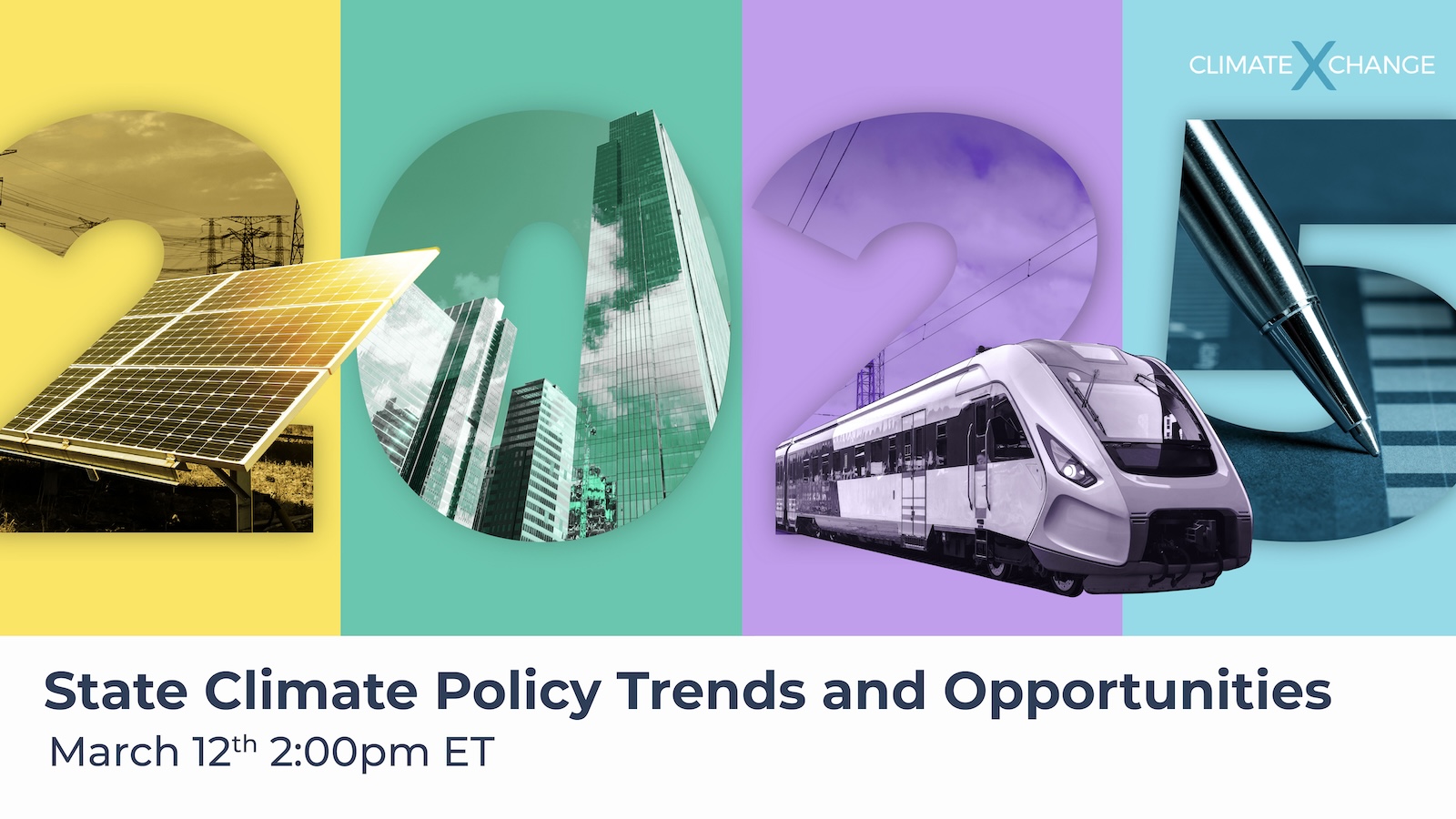
Behind every newsletter is a daily tracking operation. Our staff monitors state and federal policy in real time, tagging and tracking 2,390 bills in 2025 alone. That on-the-ground awareness allows us to identify emerging trends and share them with our network, while also providing actionable information. Utilizing our deep understanding of enacted and pending legislation, we hosted our annual webinar in March on State Climate Policy Trends and Opportunities, supplemented by a mid-year update covering everything from data centers to clean energy siting to electrifying the transportation sector. It all culminated in our year-end archive of the 305 updates we published in 2025, which documented the full arc of state climate action across the country.
In a year defined by federal turbulence, our team’s insights helped state actors navigate the ever-evolving landscape of climate policy, and we are prepared to continue delivering this critical information in 2026.

Regulating Data Centers to Address Emerging Climate and Community Impacts
Providing Foundational Policy Information and Tailored Policy Assistance
In 2025, we identified the rapid spread of data centers as one of the biggest trends impacting state-level greenhouse gas emissions targets across the country, while posing significant concerns to other state and local priorities, including energy affordability, water security, local economic development, and more. As we heard from members across our State Climate Policy Network about the impacts that data centers already posed to their communities, we realized that we needed to track this issue, offer actionable education, and identify emerging best practices for state actors.
State policymakers have a unique opportunity to confront data centers’ impact on their electric grids, ratepayers, greenhouse gas emissions targets, and local air and water. But to do so, they need to understand the challenge, their jurisdiction over it, and the evolving suite of policy tools at their disposal. And they need to act quickly.
To ground our work, our team tracked 140 different pieces of state data center legislation introduced in 2025 sessions, analyzing the issue areas they addressed and the types of policy levers that they used. We used that analysis to inform our first data center convening in 2025, where we presented our findings and listened to SCPN members on how data centers were already impacting their climate work. For us, this work highlighted that data center impacts are multi-faceted, vary significantly from state to state, and face distinct political and legislative challenges.
Our team undertook a robust research effort to better understand where data centers are likely to have an outsized impact on greenhouse gas emissions, electric rates and reliability, water systems, tax incentives, and more. We found that some states that don’t attract as much national attention may be uniquely vulnerable to specific types of data center impacts, or vulnerable at a greater scale than most observers might appreciate. That analysis was presented in our November webinar on data center impacts, and our recent brief, Identifying Priority Jurisdictions for Data Center Regulation.
We’ve also found that there are emerging policy tools that address each of the impacts that states are facing, many of which are exclusive to state jurisdiction. In 2026, to support state action on these areas, we are publishing five policy toolkits that explore what states can do to address data center impacts on energy affordability and reliability, water use, greenhouse gas emissions, transparency, and tax and employment. Later this year, we’ll be using this analysis to help drive more actionable programming for our network through a series of webinars and workshops.
The state of policy is moving at a breakneck pace in the data center space right now, as city-scale projects flood interconnection queues and threaten to overwhelm the grid. Our team at Climate XChange is committed to helping states identify trends, best practices, and model approaches to confront this wave, and help steer it towards the best climate, environmental, and social outcomes possible.
Working with Advocates to Learn from Leading States
As we’ve shared our data center resources and analysis, our team has learned from advocates across the country about how to successfully push for aggressive data center regulations at the state level. In a recent interview-based article, we recount key lessons learned from Minnesota advocates following the passage of one of the country’s biggest omnibus pieces of data center legislation in 2025, HF 16, including:
- In 2026, states should use examples like HF 16 as a baseline for what their states can accomplish.
- Advocates can leverage the emerging public sentiment against data centers to push for strong guardrails.
- Policymakers should build on existing policy processes that may be underway at the state and local level, such as Public Utility Commission proceedings addressing load growth.
- Concrete standards and reporting requirements are essential to create data center policy with real enforceability.
States Climate XChange Identified as Having the Highest Data Center Growth
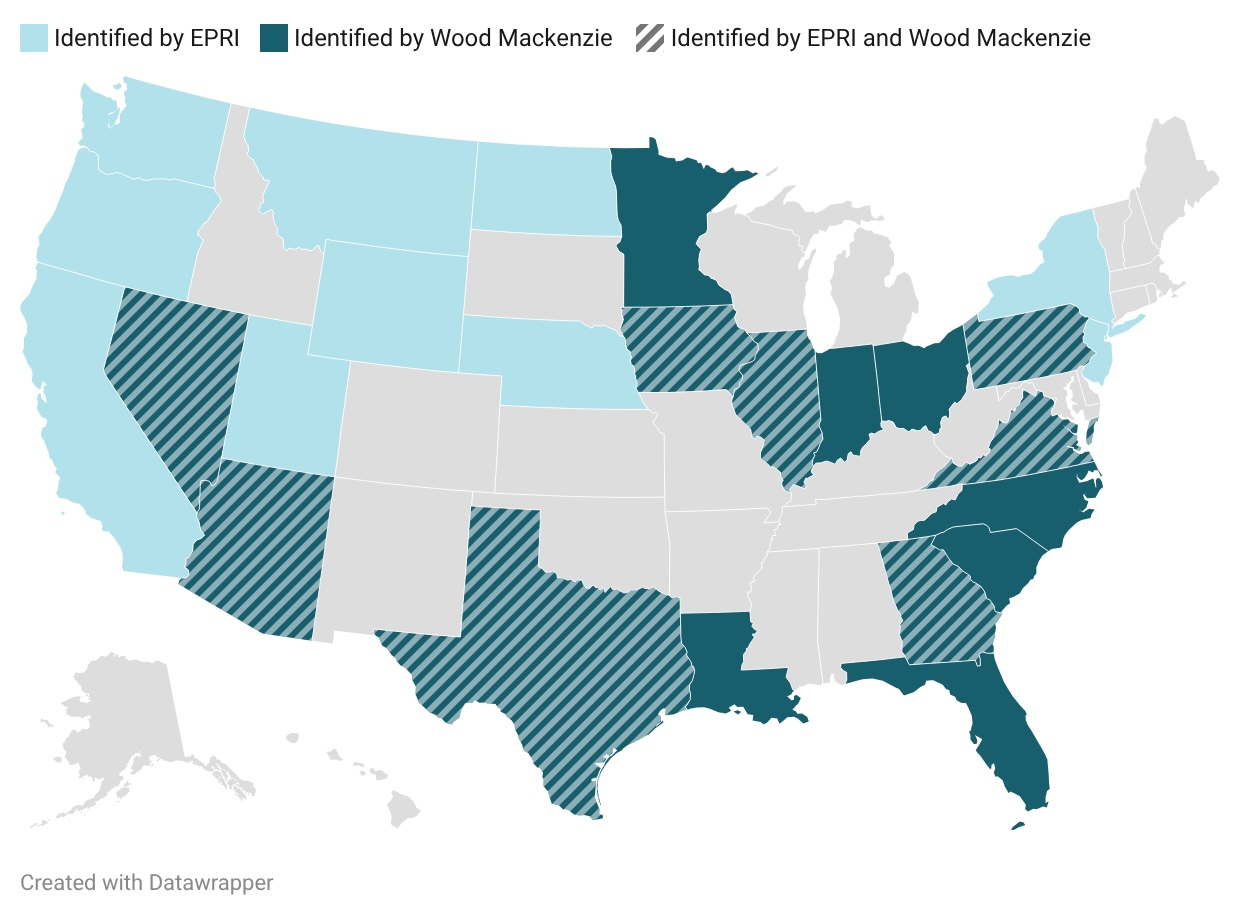
Our data center analysis relied on existing research to determine where current and future data center growth may be expected. EPRI identifies states with the highest existing data center demand and Wood Mackenzie looks at the top 15 states for future data center development based on proposed projects.
Transmission and Energy Affordability
As energy bills skyrocketed across the country in 2025, the Climate XChange team worked to support states in identifying and enacting robust policies that protect ratepayers and communities. Grid reliability became a key issue as the country grappled with record high electricity demand, fragmented and aging energy infrastructure, and increasingly frequent natural disasters.
Additionally, the rollbacks of federal climate goals made state-level climate and clean energy targets even more important. Meeting these goals requires increased electrification across sectors, as well as connecting new renewables to the grid, including solar and wind sited in remote areas. This means that every state, regardless of current electricity prices or presence of climate targets, must prioritize the modernization and expansion of its grid.
At the nexus of energy affordability, grid reliability, and clean energy deployment sits transmission — the infrastructure that delivers electricity over long distances from where it’s generated to where it’s used. In 2024, we launched a transmission series to support state policymakers and advocates in understanding and enacting state-level transmission policy, and we continued that support in 2025.
We hosted two transmission webinars focused on the role states can play in transmission reform and how states can engage in regional transmission planning. We also supported our cohort of state legislators through three legislator-only discussions on best practices for transmission legislation, as well as deeper dives into utilizing advanced transmission technologies to improve the capacity of our existing grid, and enabling the colocation of transmission lines along existing rights-of-way to streamline the deployment of new transmission infrastructure.

After laying the groundwork on the importance of transmission policy for meeting climate and clean energy goals, as well as bolstering grid reliability, we focused on energy affordability. Grid upgrades require significant investment up front to deliver long-term savings for ratepayers, but connecting these dots is difficult to communicate when bills are already rising across the country.
We hosted a webinar to review exactly how transmission saves consumers money, paired with communications best practices, to support state advocates and policymakers in discussing these difficult, technical topics with their constituencies. Through these six events, we engaged over 550 SCPN members and over 450 state legislators and legislative staff.
In addition to hosting a robust slate of events on transmission, our team recognizes the importance of free, comprehensive resources that can inform policy creation and implementation. We added coverage of policies related to enabling and incentivizing the deployment of advanced transmission technologies (ATTs) and grid-enhancing technologies (GETs) to our State Climate Policy Dashboard, so that policymakers and advocates understand the landscape of where policies are enacted, along with model policies, key research, and relevant organizations.
With energy affordability, grid reliability, and clean energy deployment continuing as critical issues for 2026 sessions, we will continue bringing programming and policy updates on these topics to the network in 2026.
Thank You
OUR WORK WOULD NOT BE POSSIBLE WITHOUT OUR GENEROUS COMMUNITY OF SUPPORTERS
We offer a sincere thank you to the foundations and individuals who supported our work in fiscal year 2025!
We received nearly
$95,000
in donations from individuals and grants from various foundations, including the DES Foundation, Mosaic Environmental Fund, and Sally Mead Hands Foundation.


Our Annual EV Raffle garnered incredible support from our community of previous supporters, with
57%
of previous supporters participating this year.
Through our raffle and other donations, over
4,500
individuals supported our work in 2025.
Climate XChange is proud to hold a four-star rating on Charity Navigator and a gold rating from Candid.

We are excited to continue producing critical work for state policymakers and advocates with the strong support of our community.
Our Financials
In fiscal year 2025, Climate XChange’s annual budget was $1.2 million. Our team is continuing to make progress on the financial goals set out in our 5-Year Strategic plan: diversifying our income sources and increasing funding from grants. Our income from grants, individual donors, and earned income was 48%.
Over 70 percent of expenses are dedicated to our programmatic work, with the remaining 28 percent supporting the organization’s administrative, management, and development costs. All of Climate XChange’s financial records can be found on our website, including a more detailed breakdown of our income and expenses.


About Climate XChange
Climate XChange (CXC) is a 501(c)(3) nonprofit dedicated to advancing equitable, evidence-based climate policy at the state level. Through applied research, policy design, and a national network of advocates and policymakers, we help shape and accelerate state-level climate solutions that cut emissions, center environmental justice, and support a zero-emissions economy. Our core initiatives include the State Climate Policy Network (SCPN), the State Climate Policy Dashboard (Dashboard), and applied research that bridges the gap between analysis and implementation—offering practical, scalable policy tools for states.
Our Programs
State Climate Policy Network
Building collective knowledge and forging new connections to boost state campaigns nationwide. Our network helps changemakers learn from experts and each other to increase the ambition, equity, and durability of state and local climate policy.


State Climate Policy Dashboard
Compiling information and resources on all 50 states’ climate progress across 67 policies to make the most comprehensive publicly available climate policy database. The platform covers all climate sectors and identifies opportunities for new policies.
Our Team
CXC has a nimble, mission-driven team committed to impact, collaboration, and powering progress in climate policymaking.

Jacqueline Adams
Senior Policy & Research Associate
Jacqueline holds a Masters degree in Public Policy from UCLA and a Bachelors in Psychology from the University of Tennessee. At Climate XChange, she supports the Policy & Research team with State Climate Policy Dashboard updates and policy tracking.

Irene Anastasiou
Operations Manager
Prior to joining Climate XChange, Irene held positions in accounting, back office operations, trading, and client relations within the financial industry. She manages the organization’s office and coordinates the logistics for our annual fundraiser.

Greg Casto
Communications Manager
Greg’s work at Climate XChange focuses on helping people understand the nuanced topic of climate policy. He is responsible for writing online content, social media, and managing all external communications for Climate XChange.
Paola Ferreira Miani
Executive Director
Paola Ferreira is an environmental policy and strategy expert with 26 years of international experience in biodiversity conservation, climate change, and energy. As Climate XChange’s Executive Director, Paola leads our organization by spearheading our 5-Year Strategic Plan.

Jordan Gerow
Policy & Research Director
Jordan is an environmental lawyer with a deep background in state-level electricity law and policy, and a broader background in model approaches to decarbonization topics across many sectors. He brings over a decade of experience to leading Climate XChange’s Policy and Research team.

Brynn Madore
State Climate Policy Network Associate
Brynn is a master’s student at American University with a background in clean energy at the state, regional, and federal levels. At Climate XChange, she assists with events and outreach for the State Climate Policy Network.

Amanda (Griffiths) Pontillo
Communications Director & Operations Lead
Amanda comes to Climate XChange from the Massachusetts State House, where she focused on energy and environmental policy. She oversees the organization’s content creation and brand identity, as well as operations for the team.

Kristen Soares
State Climate Policy Network Manager
Kristen is a UCLA graduate with a degree in Environmental Science and Public Affairs. At Climate XChange they manage the SCPN: conducting outreach, organizing webinars, and facilitating connections between state climate actors.

Ruby Wincele
Policy & Research Manager
Ruby manages the State Climate Policy Dashboard and leads the organization’s policy tracking. She uses her knowledge of state-level climate policy landscapes and emerging trends to share best practices with advocates and policymakers across the country.
Our Board
Sukia Akiba
Sukia is currently pursuing a PhD in Public Policy at UMass Boston, with experience spanning sustainable real estate development, project management, and community advocacy.
Shiladitya DasSarma
Shiladitya is a Professor at the Institute of Marine and Environmental Technology and School of Medicine at the University of Maryland.
Kalman Gacs
Secretary
Kalman is the Project Manager and Creative Director at Viv Web Solutions, but found his start making digital graphics for the climate movement.
Peter Kirby
Raffle Director
Peter was a former strategy consultant and executive for IBM, who more recently invested his time and assets to fight the climate crisis.
Jack Kutner
Jack is an executive with 40 years of experience, currently consulting for start-up and early-stage companies with a focus on sustainability-based businesses and non-profit organizations.
Laura Teicher
Laura is the Executive Director at FORGE, a nonprofit that helps startups navigate the journey to reach impact at scale.
Mary Wambui
Mary Wambui is an affordable housing asset manager for the Planning Office for Urban Affairs, a non-profit social justice ministry of the Roman Catholic Archdiocese of Boston, and is involved in numerous Massachusetts-based organizations.
Quinton Zondervan
Chair and Treasurer
Quinton is a former Cambridge City Councillor and currently serves as the Policy Director at Run On Climate. He has used his business and technology background to start and lead several companies and nonprofit organizations.