Authors
Jordan Gerow | Policy & Research Director
Kristen Soares ǀ State Climate Policy Network Manager
Contributors
Ruby Wincele | Policy & Research Manager
Jacqueline Adams ǀ Senior Policy & Research Associate
Data centers have been a top policy priority for states over the last two years, and in 2026 these efforts continued to gain momentum. Across the country, states succeeded in passing measures to regulate these facilities’ impacts to energy affordability, grid reliability, water resources, emissions, and economic development. And this momentum wasn’t only carried by policymakers: On the ballot, voters approved stricter state and local data center guardrails in 46 of 47 measures throughout the year. Polling continues to show that the public dislikes the resource-hungry facilities, with 70 percent of Americans opposing data center construction in their area as of March 2026 — almost 20 points higher than those who oppose a nuclear power plant.
Electricity affordability was a major trend in data center policy this year, as states responded to communities’ demands that data centers pay their fair share for grid infrastructure amidst a nationwide energy affordability crisis. This, along with grid reliability concerns, spurred new requirements for facilities to bring their own new energy, with some states stipulating the energy must be clean.
Many states also enacted requirements for data centers to disclose their energy, water, and economic impacts, and some directed statewide assessments of these impacts to state resources in an effort to equip policymakers with the information they need to build out concrete regulatory frameworks. In the same vein, almost a dozen states reformed, paused, or ended data center incentives while impacts are being studied or regulations promulgated. We also saw the first statewide pauses on data center development, mostly through Executive Orders.
Momentum is building in the realm of water regulation, with a handful of states prohibiting adverse impacts to state water resources. Policymakers are also working to prioritize local decisionmaking, with states beginning to create robust frameworks mandating that data centers conduct community engagement and ensure local benefits.
Dive deeper into Climate XChange’s Resources for Regulating Data Centers, including:
- State Policy Toolkits for Data Center Regulation, complete with live bill trackers, example policies, and one-pagers.
- 2026 Data Center Bill Tracker
- Model State Law: Creating Low Emissions, Accountability, and New Generation Rules for Infrastructure and Data Centers (CLEAN GRID Act)
2026 State Legislative Recap
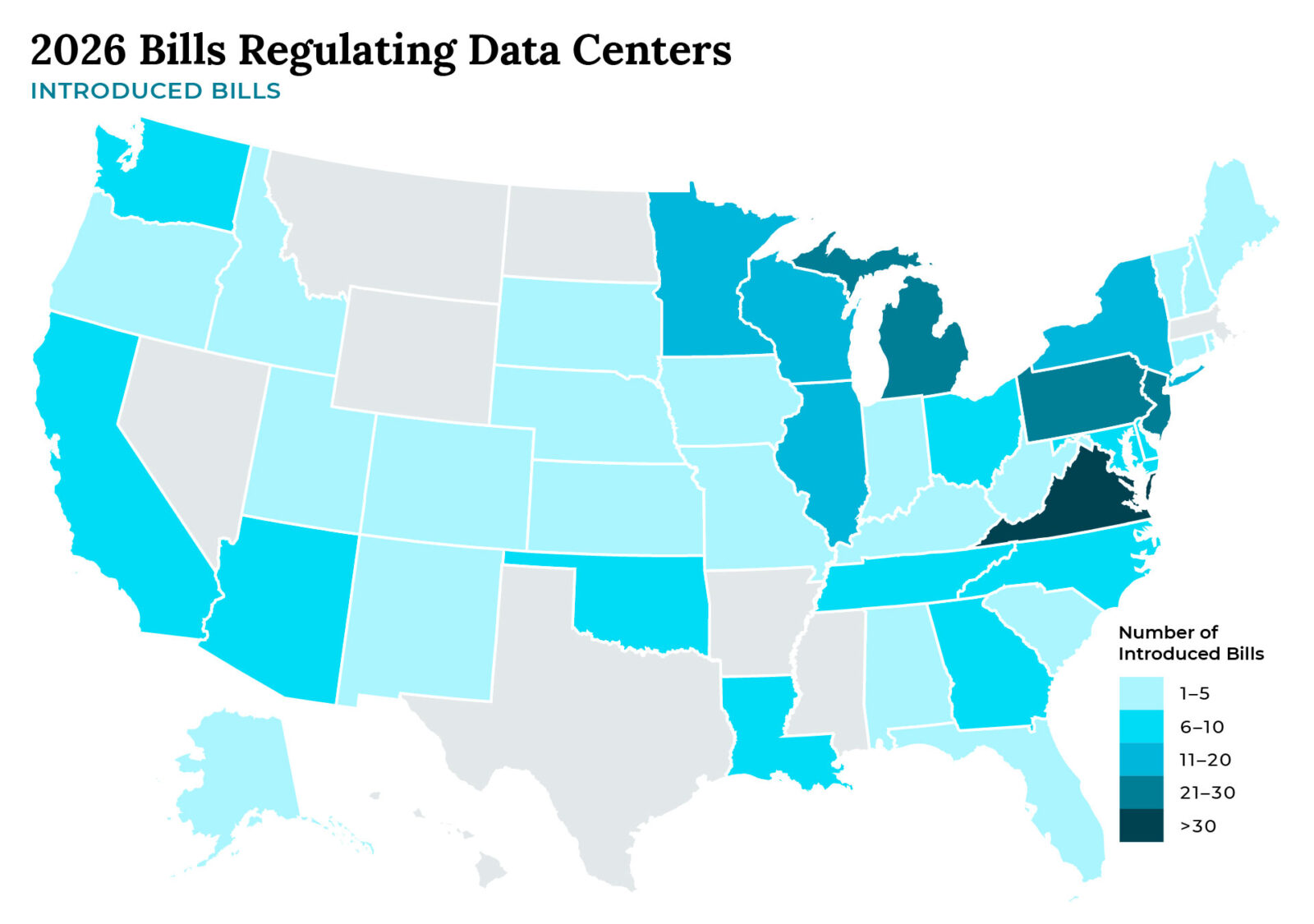
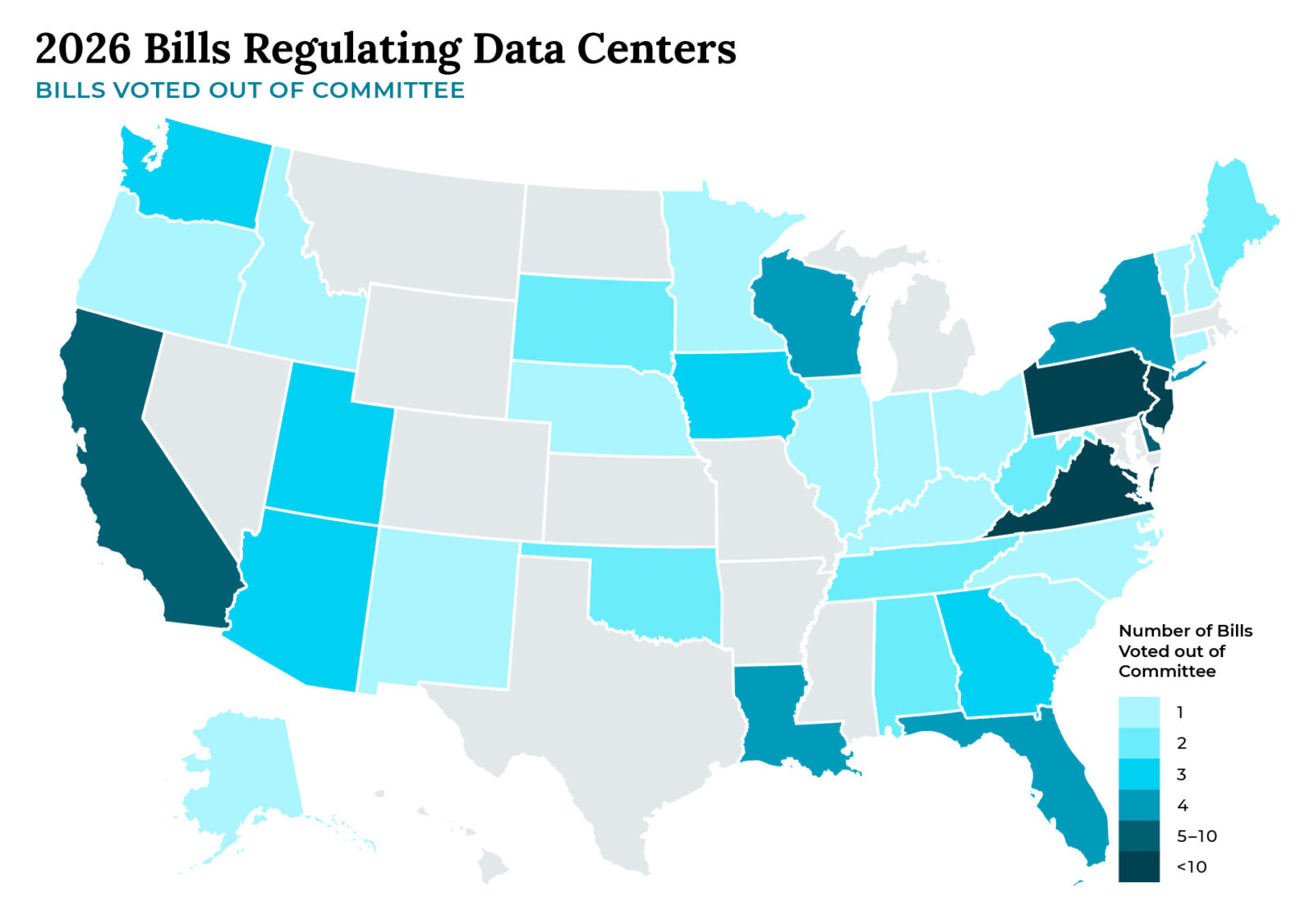
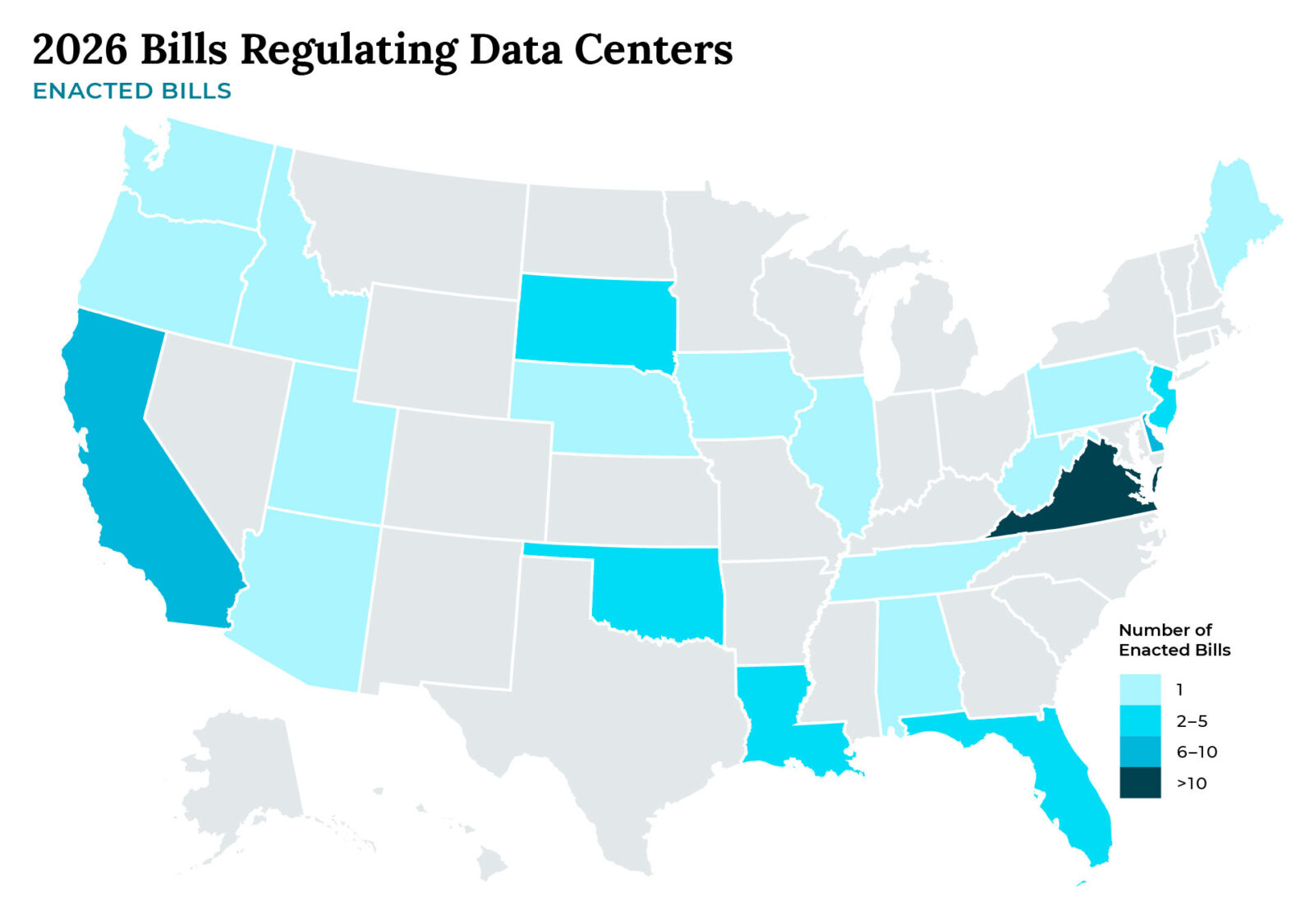
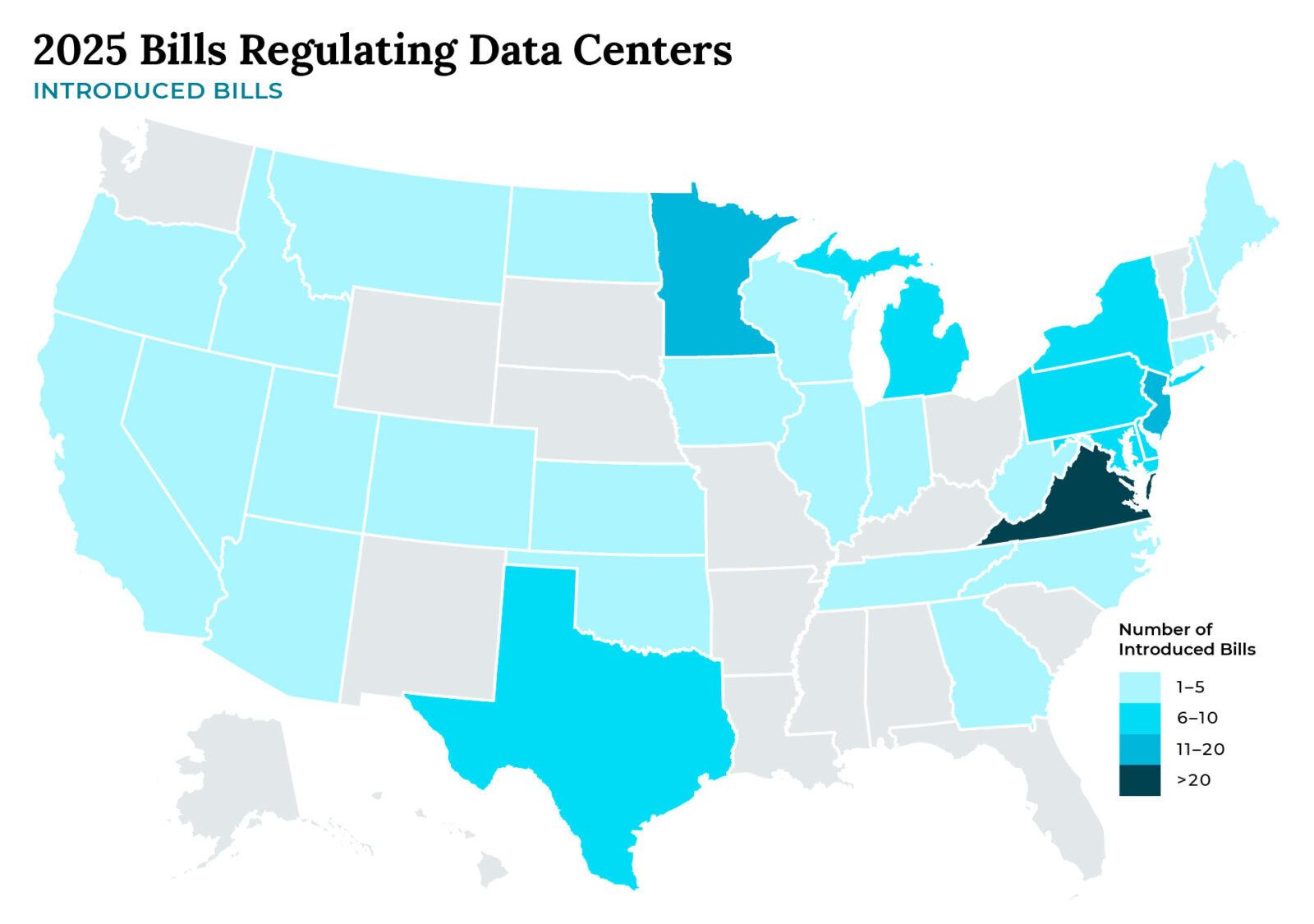
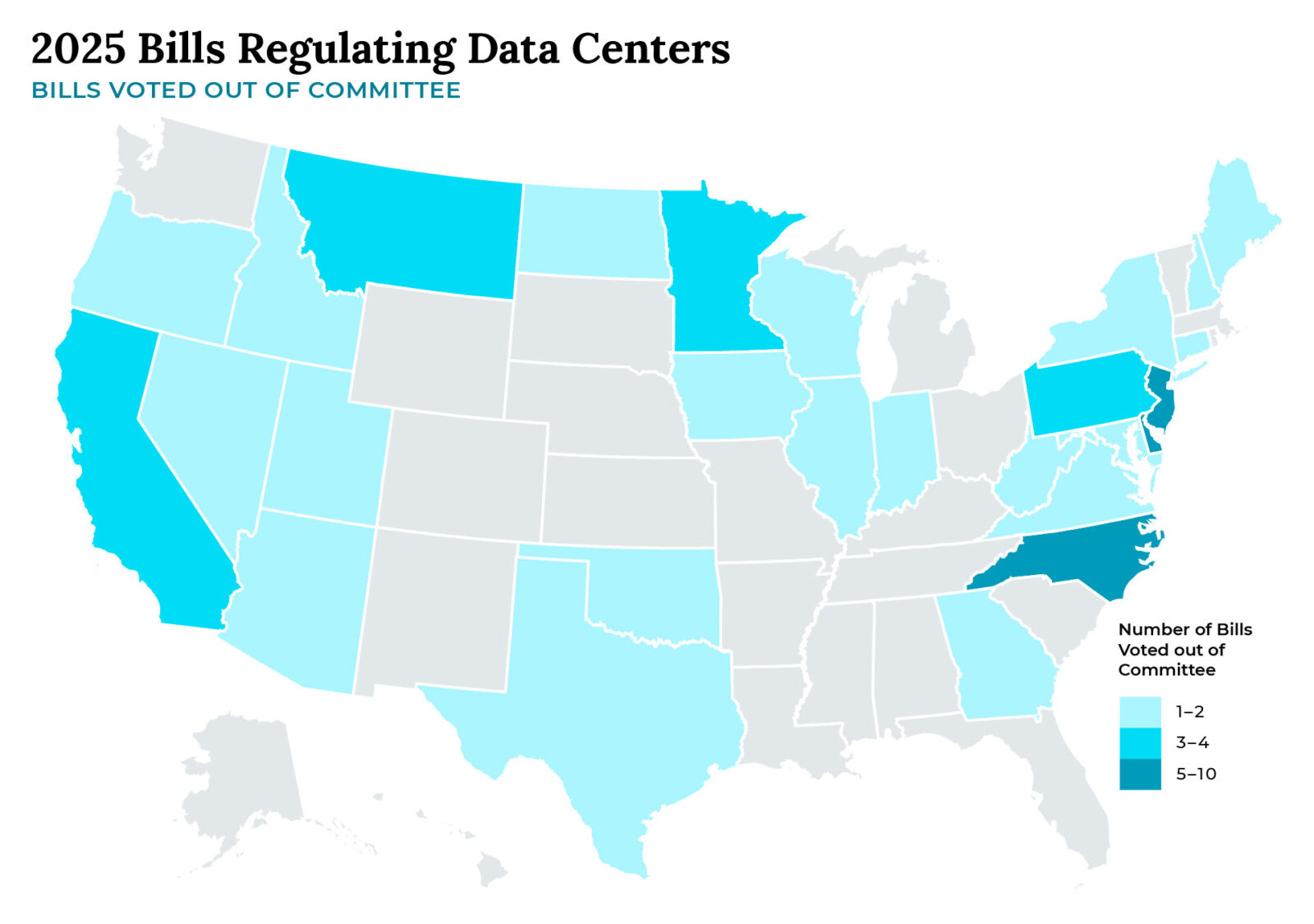
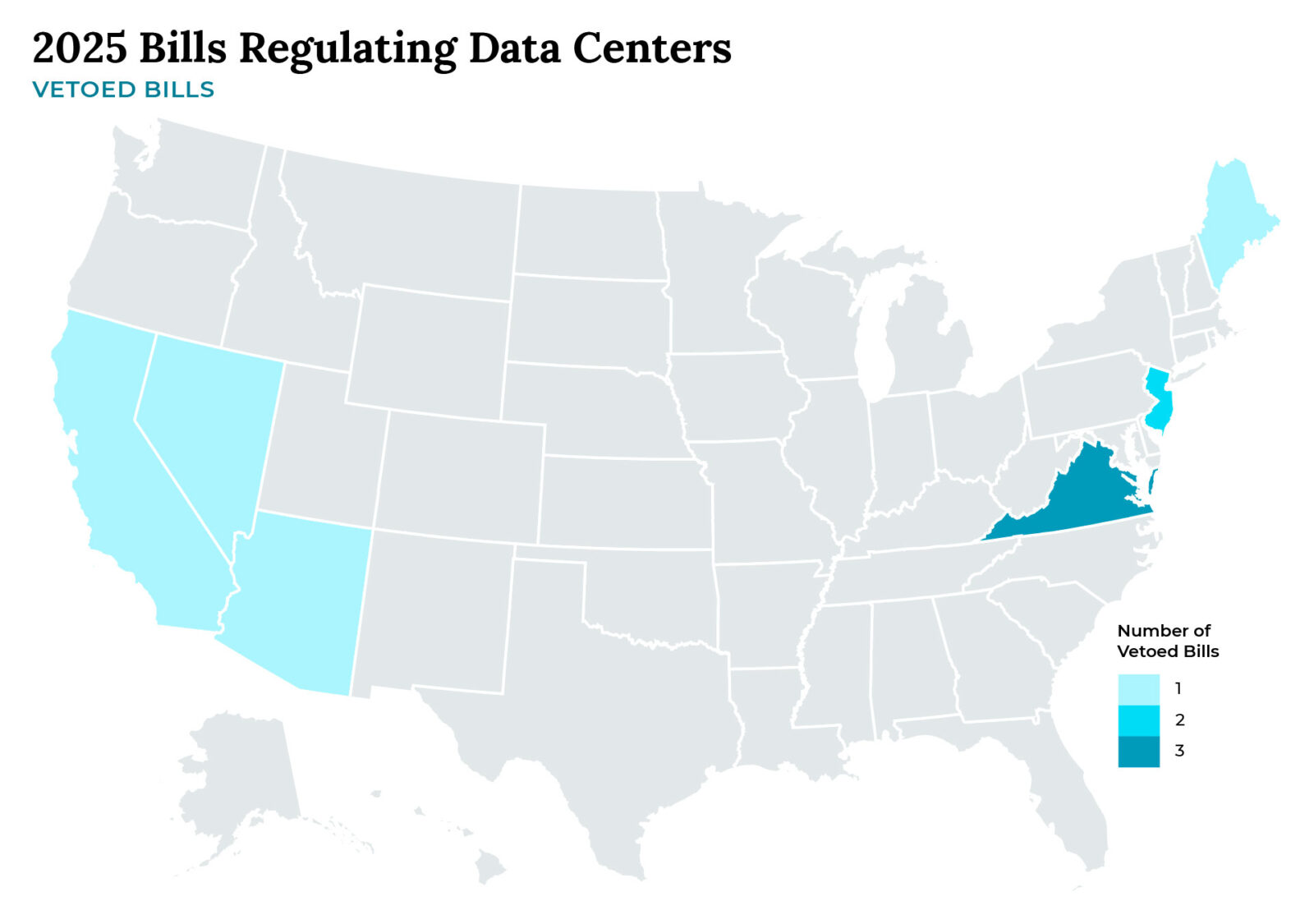
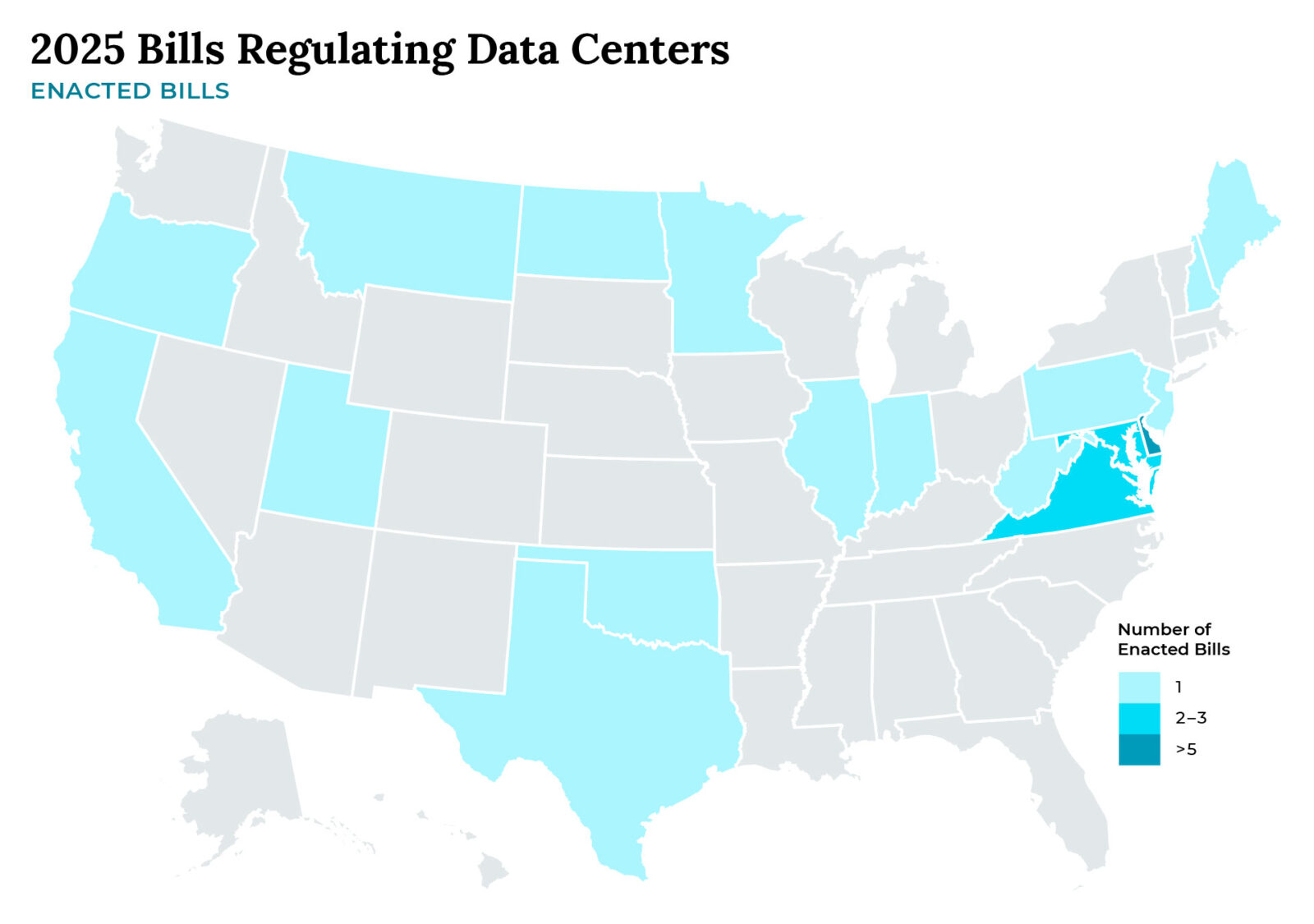
In 2026, state legislatures considered at least 318 bills across 41 states to regulate data centers. However, only 59 of these were enacted in 21 states. This was more than twice as many bills as the year before, with 156 bills introduced across 32 states in 2025 (27 of which were enacted across 18 states).
The themes of data center legislation have also evolved over the last two years. Legislation introduced in 2025 was largely centered around studying data center impacts and incentivizing, but not mandating efficiency and impact mitigation measures, and many bills were focused on a single issue area, such as electricity affordability or water. In contrast, 2026 legislation was more direct, enforceable regulation and a trend toward comprehensive coverage across energy, environmental, and economic impacts.
Administrative Leadership: The Role of Governors and Utility Regulators
In 2026, states also sought non-legislative approaches to enacting data center policy, namely through the authority of governors — with at least 20 executive actions across 16 states, including data center pauses in Oregon, Texas, and New York.
Governors in ten states (Virginia, Massachusetts, Pennsylvania, Kentucky, Wyoming, Utah, Missouri, Maryland, Maine and Oregon) signed Executive Orders (EOs) to mitigate facilities’ impacts across energy, environmental, and community issues. The governors of Maryland, Maine, and Oregon also ordered the creation of specific data center advisory groups to assess these impacts across their states. Governors issued EOs directing the development of large load tariffs in New Jersey and Virginia, and halted data center incentives in Nebraska, Massachusetts, Illinois, and Ohio.
Public Utility Commissions (PUCs) also play a lead role in data center regulation. PUCs set the rates data centers pay for their power, can specify where that power comes from, and impose other operational requirements on data centers. The most prominent vehicle by which PUCs influenced data center development in 2026 was through large load tariffs, a special, higher rate for customers who use a lot of energy.
This year, the Database of Emerging Large Load Tariffs tracked over 115 different PUC dockets regulating data center rates, as well as a number of other tariffs developed through smaller, utility-specific filings. In many states, PUCs are also at the forefront of approving generation to serve data centers, establishing interconnection procedures for data centers, or even developing a queue system to serve data centers as clean energy becomes available to serve them.
FERC Action Pending
At the federal level, regulators continue to reconsider the rules around how the largest data center projects interconnect with the transmission grid. In June 2026, the Federal Energy Regulatory Commission (FERC) issued six orders tailored to the nation’s major grid operators, directing them to address: 1) transmission service application standards and study processes; 2) measures to prevent cost shifts onto other ratepayers; 3) accommodations for data centers co-locating with generation; and 4) the provision of flexible power supply for data centers.
Following an extension from FERC, responsive filings from each grid operator are due throughout late November, with a 30-day window for intervenor comments to follow. These efforts at the federal level might have the effect of better informing some state policy — such as determining the transmission costs attributable to data centers — while potentially making it faster and easier to interconnect hyperscale facilities.
2026 Trends in Data Center Policy
Comprehensive Data Center Approaches: State Moratoria and Omnibus Policies
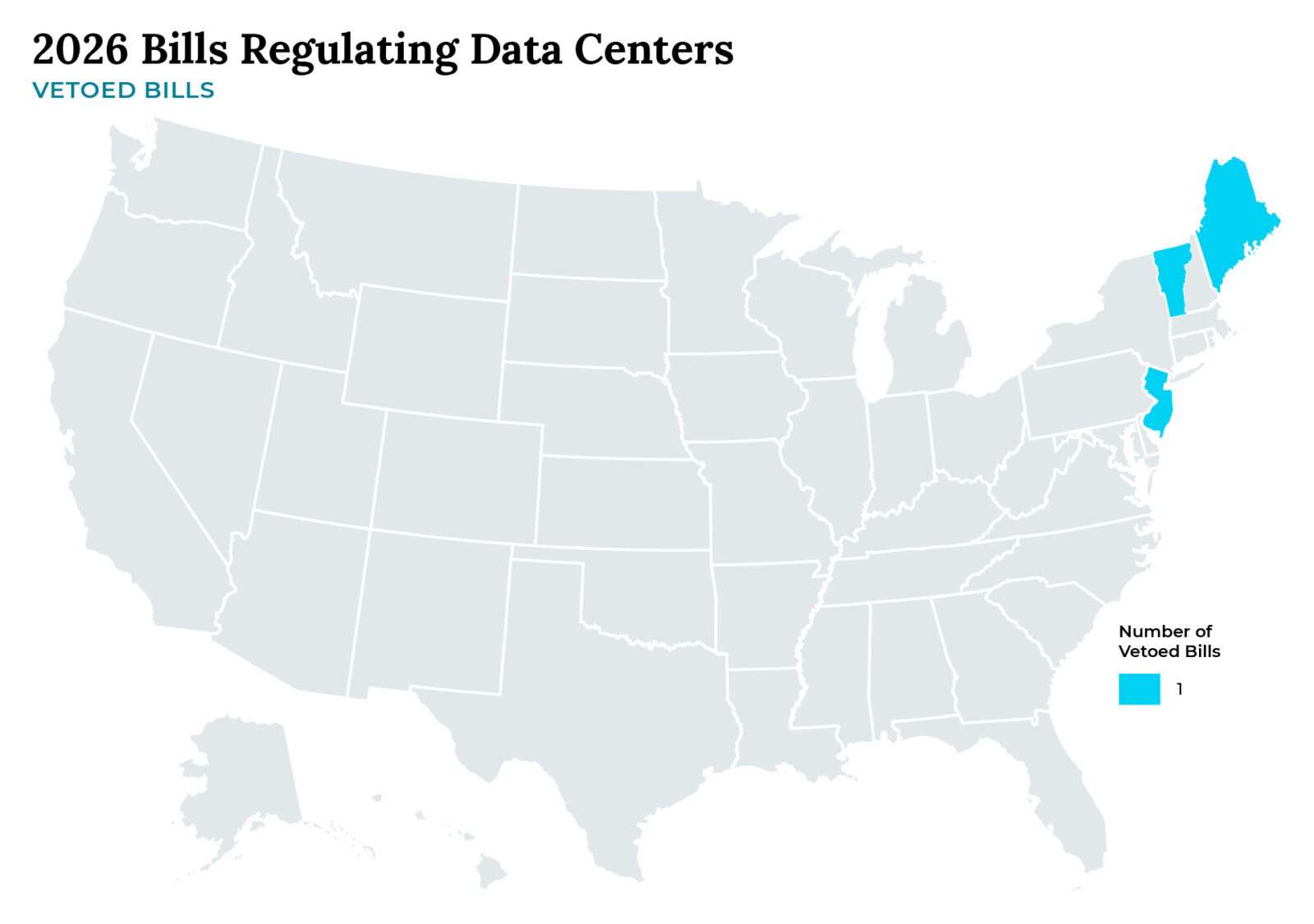
As data center development threatens to outpace regulations, communities have sought moratoria to give them time to assess impacts and develop policy frameworks. While localities have enacted over 300 moratoria over the last two years, state legislatures did not pass any until this year. In 2026, at least 31 state-level moratorium bills were introduced across 18 states, but none became law and two-thirds never even made it out of committee. While both chambers of Maine’s legislature passed a moratorium bill in April, aiming to suspend approvals for data centers over 20 megawatts (MW) until November 2027, Governor Janet Mills vetoed it, citing a specific project that should have received an exemption.
Three states established temporary moratoria on data centers through executive actions (New York, Texas, and Oregon), giving them an opportunity to conduct statewide assessments to understand and mitigate data center impacts.
Many states enacted comprehensive data center regulations in 2026, holistically addressing energy, water, emissions, tax, and transparency issues. Many of these were promulgated through executive actions (including Virginia, Massachusetts, Pennsylvania, Kentucky, Maryland, and Wyoming) with one legislative package enacted across seven bills in California.
There were a few key themes in most of these frameworks, reflecting core priorities across geographic, economic, and political contexts:
- Energy affordability: Utilizing large load tariffs or other measures to ensure data centers pay their fair share for grid costs and upgrades.
- Facility-level transparency: Disclosing facility-specific energy and water use, economic impacts, and duplicate interconnection requests across territories, as well as banning the use of non-disclosure agreements (NDAs).
- Community benefits: Centering local voices when deciding if and how a data center gets built, through community benefit agreements (CBAs), commitments to local employment, and other pledges.
- Statewide assessments: Initiating assessments of data center impacts across the state, including on energy demand, grid reliability, and emissions.
- Clean energy procurement: Requiring or incentivizing facilities to use clean energy.
Affordability Trends: Large Load Tariffs
Over the last two years, concerns about data centers’ impacts on electricity prices have become a dominant trend in state policymaking and regulatory ratemaking. Most states address this concern through a large load tariff — a special utility rate charged to customers that consume more than a certain amount of power, requiring investments in the transmission and distribution grid to serve them. Of the 134 different large load tariffs in effect or under review around the country, over 85 percent of them originated in 2025 or 2026 (some earlier examples, dating as far back as 2018, were developed to apply to other industrial customers). These tariffs are now present or proposed in 40 different states, albeit with very different terms from jurisdiction to jurisdiction.
Climate XChange’s State Policy Toolkit for Data Center Regulation of Electricity Affordability and Reliability Impacts covers different tools states can use to prevent data centers from passing costs and risks on to other customers.
In 2026, Climate XChange tracked 14 pieces of enacted legislation requiring the development of large load tariffs (or similar contracting requirements), as well as several similar actions from utility regulators around the country. Some of these bills, like Tennessee’s HB 1847, are relatively simple, requiring data centers to pay for all dedicated grid infrastructure serving them, and authorizing the development of large load tariffs to achieve that goal. Some examples, like Nebraska’s HB 1010, also incorporate grid reliability concerns by requiring utility regulators to develop procedures for curtailing data center load during periods of grid strain. Others, like California’s AB 2383 and Delaware’s HB 233, explicitly acknowledge that these rates should be designed to ensure that utilities continue to meet their renewable energy requirements.
Looking ahead: While large load tariffs will continue to be a vehicle for addressing affordability concerns arising from data centers, we look forward to other tools emerging in 2027. For example, removing the utility’s obligation to serve these customers (see Delaware’s SB 276) would allow utilities to reject an application for service from a data center, even where it is technically possible to serve them.
Climate XChange’s Model State CLEAN GRID Act includes terms addressing several of these trending issues, including Bring Your Own Power requirements (and associated penalties for noncompliance), attributing grid costs to the data centers causing them, removing the utility obligation to serve these facilities, and more.
Emissions Trends: Bring Your Own (BYO) Power
As data centers strain electricity capacity, regulators are increasingly looking for them to follow a “BYO” approach — meaning data centers must bring their own power to the grid. However, not every state has deployed this strategy to require that this additional energy is clean. How policymakers approach this requirement in the future may determine the emissions impacts of data centers, both in terms of greenhouse gases as well as local air pollutants.
Climate XChange’s State Policy Toolkit for Data Center Regulation of Greenhouse Gas Emissions covers many legislative, regulatory, and administrative approaches to reducing GHGs from data centers.
In 2026, we tracked several different legislative and executive actions requiring data centers to bring their own power, each of which approached clean energy differently. Some types of enacted requirements include:
- Incentivizing clean energy: New Jersey’s A.796 required that the Board of Public Utilities should design rules to incentivize data centers to bring their own new, clean energy generation or storage, within the context of establishing rules for interconnecting large load customers. Similar principles were advanced in Virginia’s Data Center Accountability Framework and Delaware’s HB 310.
- Increasing clean energy targets: Pennsylvania’s Executive Order 2026-05, as implemented through the Department of Environmental Protection’s GRID Project Consent Order, requires data centers to bring their own capacity and energy, with an increasing percentage of that requirement coming from dispatchable, clean firm energy resources (like nuclear, hydro, geothermal, or fossil with carbon capture). Those targets rise from 10 percent to 32 percent by 2035, which is higher than the state’s renewable portfolio standard.
- Outpacing existing clean energy targets: Delaware’s HB 445 requires that data centers either procure or produce their own new power, and that self-produced power meets the percentage target under the state’s renewable portfolio standard for the last year the data center is expected to operate. These types of requirements will tend to push data center power to be somewhat cleaner than the prevailing requirements for the state, without rising to a strict 100 percent clean target.
- Fully clean targets, with qualifications: Massachusetts’ Executive Order No. 658 requires data centers to procure incremental new clean energy generation to meet 100 percent of their annual consumption, or else pay into a Ratepayer Protection Fund if their procurement is insufficient.
Looking ahead: Several states proposed legislation requiring ambitious new clean energy targets for data centers in 2026 sessions and many more may join them in 2027. When setting such targets, structuring compliance mechanisms and penalties will be critical to a policy’s success. Illinois’ SB 4016, for example, proposed that data centers might face curtailment requirements proportional to the amount of load they fail to meet with new clean resources. Climate XChange’s Model State CLEAN GRID Act outlines similar terms.
Water Trends: Disclosures and Impact Mitigation
Data centers’ water usage continues to be a key concern for state policymakers and the communities they serve, and many 2026 policies aimed to address facilities’ on-site water consumption, especially related to cooling.
Climate XChange’s State Policy Toolkit for Data Center Regulation on Water Impacts covers the vast array of legislative mechanisms states can use to protect their water resources and reduce on-site water usage.
The biggest trend in water regulation this year centered on transparency, with at least ten states requiring that data centers report various aspects of water usage, including:
- Water withdrawal, consumption, and discharge (e.g., California, New Jersey, Pennsylvania, Virginia, and Nebraska)
- Water efficiency measures (e.g., California, Texas, and Florida)
- Impacts to watersheds and compatibility plans (e.g., South Dakota and California)
- Water pollution mitigation measures (e.g., Pennsylvania and Utah).
A handful of states also teed up assessments on statewide data center water usage and impacts (e.g., Maryland), including through moratoria (e.g., New York and Texas), as well as the development of policy recommendations to strengthen water regulation (e.g., Florida and Oregon).
Some states went beyond disclosure requirements to directly mitigate data centers’ on-site water usage. Some chose to condition data center permits on whether their water usage and/or discharge would cause adverse impacts to the state’s watersheds or existing water customers, while others directly required or encouraged water efficiency or conservation measures for facilities.
- Mitigating impacts to watersheds: At least five states required that data centers water usage does not adversely impact watershed quantity and/or quality (e.g., Kentucky, Utah, Florida, West Virginia, and Massachusetts).
- Minimizing water use: A handful of states required that data centers minimize their water consumption through the use of water-efficient technologies (e.g., Massachusetts and Oklahoma), while others incentivized or encouraged water efficiency measures (e.g., Virginia, Wyoming, and California).
A few states also established noncompliance fees if data centers fail to adhere to water reporting and impact mitigation requirements (e.g., Texas, Pennyslvania, and Utah).
Water protections were more successful in 2026 than in 2025, when only three of the 27 proposed state bills addressing data centers’ water usage were enacted. Themes across water-related legislation under consideration in 2025 mainly revolved around disclosing and studying data centers’ water usage and impacts, as well as incentivizing the usage of water efficiency measures. In 2026, legislation shifted towards mandates for water conservation and impact mitigation.
Looking ahead: Only a few states require data centers to pay for their costs related to water service and treatment infrastructure (e.g., California and Massachusetts), and more states should follow their lead to protect consumers as they have for electricity affordability. Additionally, while many states took steps toward protecting their water resources from data center impacts, few required the development of specific water usage or efficiency standards applicable to all data centers, leaving much to the discretion of state agencies. These guardrails were also overwhelmingly focused on on-site water usage, while a majority of data centers’ water usage is indirect — related to the generation of energy used to power their facilities — a concern that has not been adequately addressed by state policy to date.
Tax Trends: Rescinding, Pausing, and Reforming Tax Subsidies
The sudden rise in data center development has had an unexpectedly large impact on state and local tax revenue, as multi-billion dollar projects claim subsidies (offered in approximately 40 states) that were often designed for a much smaller industry. As states better understand the scale of revenue lost to these subsidies, and the comparatively low job numbers delivered by these projects, they are revisiting these incentive mechanisms by reforming, pausing, or outright rescinding them.
Climate XChange has written more about state options to pause or reform their data center subsidies in our State Policy Toolkit for Data Center Regulation on Tax, Employment, and Economic Impacts.
In 2026, we tracked several enacted legislative and executive actions addressing data center subsidies:
- Reforming tax subsidies: In lieu of the total elimination of tax subsidies, some states tried reforming them to better capture the type of data center development they would like to encourage. Delaware’s HB 310, for example, amends tax credits to require that eligible data centers either produce or procure new energy meeting 100 percent of their demand.
- Pausing tax subsidies: Several governors took action to pause the administration of tax subsidies while the state considers data center impacts, including Illinois, Massachusetts, and Ohio. The Arizona 2026 state budget (HB 4168) notably includes a three-year pause on data center tax incentives.
- Ending tax subsidies: Several states simply eliminated certain data center tax incentives, including New Jersey, Oregon, Washington, and Maine.
Looking ahead: As states remove these unnecessary subsidies for data centers, they might look at innovative ways to tax the industry in order to deliver benefits to local communities. For example, Virginia Governor Spanberger signed the 2026-2028 budget (HB 30), which imposes an electricity-use tax on data centers at $0.011 per kilowatt-hour in 2027 and 2028.
Community Engagement Trends: Supporting Local Decisionmaking
In defining state-level data center guardrails, state policymakers also sought to preserve local decisionmaking. Many of the broadsweeping data center policy frameworks, moratoria, and incentive reforms enacted this year included language on community engagement and benefits, with states requiring engagement early and often that results in clear, enforceable community benefit frameworks with commitments across energy, environmental, and employment issues.
- Mandate engagement: Require robust community outreach plans with details on community engagement opportunities (e.g., Pennsylvania) and commitments to full transparency on addressing community concerns (e.g., Kentucky).
- Provide local technical support: Provide funding and/or technical assistance to local governments so that they can meaningfully participate in siting decisions (e.g., Maryland), and guidance for local stakeholders engaging with data center developers (e.g., Pennsylvania).
- Require local approval: Require that data center projects provide proof of all necessary local engagement and approvals before receiving necessary state permits (e.g., Virginia and Pennsylvania), and preserve local authority to regulate or prohibit data centers (e.g., South Dakota).
Looking ahead: Mandating the mere existence of a community benefit agreement (CBA) is not necessarily enough to provide direct, lasting benefits to communities. States should seek to truly center communities in the development and implementation of community benefit commitments, such as through Illinois’ proposed legislation to create a community benefit fund managed by the community, and funded and disclosed by developers. Michigan’s proposed legislation also offers a model allowing local governments to reject a data center permit if the CBA does not adequately benefit communities.
Moving into 2027
In 2026, states laid solid groundwork for the types of comprehensive regulation of the data center industry that will be required. Most state action has focused on foundational issues like transparency, pausing subsidies, and ensuring data centers pay their fair share of system upgrades. Moving into 2027, the time is ripe for states to pursue more comprehensive and enforceable standards on energy and water use, tax treatment, and community benefits. Climate XChange is here to support state policymakers and advocates in pushing for:
- Robust requirements for additional, deliverable, and time-matched clean energy, including financial or operational penalties for noncompliance.
- Specific water efficiency and usage standards, as well pay-for clauses for water infrastructure upgrades.
- Required community benefits, including minimum terms covering workforce development, community investments, environmental and public health mitigation measures, noise limits, decommissioning, and more.
- Taxing data centers for their emissions or power usage.
In addition, states that have taken strong executive action on data centers should prioritize codifying these actions into legislation.
As state policymakers and advocates seek to establish or strengthen these guardrails, Climate XChange will continue to provide policy tracking, analysis, and technical assistance free of charge. For more information on how we can support your work on the ground, reach out to kristen@climate-xchange.org.